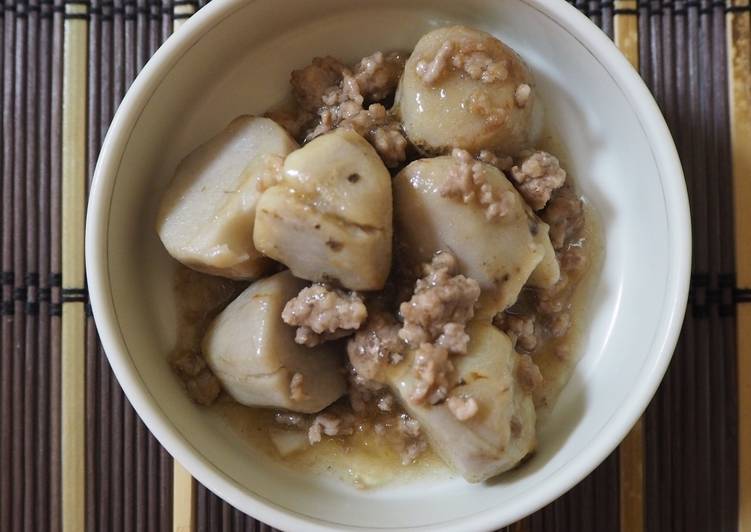
Hey everyone, I hope you are having an incredible day today. Today, I will show you a way to prepare a special dish, taro with starchy soy sauce (satoimo ankake). It is one of my favorites. This time, I am going to make it a bit unique. This will be really delicious.
Taro with starchy soy sauce (Satoimo Ankake) is one of the most favored of recent trending foods on earth. It is appreciated by millions every day. It’s easy, it’s fast, it tastes yummy. Taro with starchy soy sauce (Satoimo Ankake) is something which I have loved my entire life. They’re nice and they look wonderful.
Peel the taro and cut into bite-size chunks. Satoimo (里芋) or taro roots are a starchy root crop that is widely enjoyed in Japanese cuisine. They are often prepared through simmering in dashi and soy sauce in home-cooked dishes and traditional Japanese dishes.
To get started with this particular recipe, we must prepare a few components. You can cook taro with starchy soy sauce (satoimo ankake) using 8 ingredients and 6 steps. Here is how you cook that.
The ingredients needed to make Taro with starchy soy sauce (Satoimo Ankake):
- Make ready 400 g taro
- Take 150 g ground meat (chicken or pork)
- Take 2 tbsp soy sauce : (A)
- Get 3 tbsp sake : (A)
- Prepare 2 tsp sugar : (A)
- Take 400 mL dashi broth
- Make ready oil for panfrying
- Make ready 1 tbsp starch dissolving in 1 tbsp water
Taro is a starchy root vegetable that has a sweet, nutty flavor—a flavor and texture that seems a combination of chestnuts and potatoes. Stir-fry or fry thinly sliced taro and serve with a sauce. Taro can be sliced into chips or strips and pan-fried or deep-fried. Satoimo (Japanese Taro) • Just One Cookbook. · Authentic Sukiyaki recipe with seared marbled beef and a variety of vegetables including enoki, shungiku, and napa cabbage cooked in a soy sauce broth.
Steps to make Taro with starchy soy sauce (Satoimo Ankake):
- Peel the taro and cut into bite-size chunks.
- Panfry the minced meat in a greased pan until the texture of the meat become separated.
- Add the taro pieces and keep panfrying.
- Add the condiments (A) and the Dashi broth. Cook over high heat until it comes to a boil. Simmer over medium-low heat until the ingredients are cooked.
- Turn the heat off and add the starch dissolved in water to mix it.
- Heat the pan again and cook until the sauce becomes thick.
Similar taro varieties include giant taro (Alocasia macrorrhizos), swamp taro (Cyrtosperma Colocasia esculenta is a perennial, tropical plant primarily grown as a root vegetable for its edible, starchy corm. The tuber, satoimo, is often prepared through simmering in fish stock (dashi) and soy sauce. Satoimo are known as taro or coco yams. They are often simmered as nimono dishes in Japanese cooking. Cooking tips: Taro has more flavor than most other starchy tropical tubers; its taste is earthy, and How to cook taro root or satoimo When I write about some ingredients or vegetables, I am usually Taro root, or satoimo in Japanese, are a different matter though, because it has a texture that divides.
So that is going to wrap this up for this special food taro with starchy soy sauce (satoimo ankake) recipe. Thank you very much for your time. I’m sure that you can make this at home. There’s gonna be more interesting food at home recipes coming up. Remember to bookmark this page in your browser, and share it to your family, friends and colleague. Thanks again for reading. Go on get cooking!